Refund evidence for delivery orders: fixed camera, phone app or computer vision
Both major platforms tell restaurants to attach evidence to a dispute. Nobody explains how a kitchen produces it during a Friday peak. There are three practical answers, and they are not equally good.


The decision usually gets made backwards. A run of unfair charges arrives, somebody says “can we not just put a camera up”, and six months later there is a camera nobody looks at. Better to start from what the platforms accept, then ask which approach produces it during the busiest twenty minutes of the week.
What counts as evidence in a missing item claim?
An image that identifies the order, shows every item, and was clearly captured before dispatch. Uber Eats tells merchants to “attach photo or video evidence to strengthen your dispute case”. Deliveroo, for non-food and retail disputes, requires “photo evidence of the refunded item or items and order receipt, within the same image, at the point of packaging or prior to dispatch”.
Deliveroo’s wording covers one category, and it is still the most precise published description of a persuasive case: items and receipt in one frame, before the bag leaves. Any method that cannot produce that produces something weaker.
Approach one: CCTV or a fixed camera over the pass
A camera records the packing area continuously and you go looking for the relevant minutes when a charge arrives. It is the cheapest to install, asks nothing of the team during service, and it is the approach most likely to be quietly abandoned within a quarter, because the retrieval cost per dispute is brutal.
What defeats it is not the recording, it is the search: the time of the order, footage not yet overwritten, an angle where the open bag is visible rather than a packer’s back, and the resolution to tell two similar boxes apart. Ten or fifteen minutes of admin for an adjustment worth a few pounds. Its one real advantage is that it also captures the handover, so it can settle which rider took which bag.
Approach two: a phone app for photographing the packed order
Someone photographs each order before sealing it, through an app that files the image against the order. It produces exactly the right kind of evidence, costs almost nothing to start, and depends entirely on compliance holding up during the twenty minutes when it matters most.
The failure mode is worth naming: photo compliance decays under load. Coverage looks excellent for a fortnight, then slips on peak Saturdays, which is where the disputes come from. Ten to twenty seconds per order is a tax on the busiest station, and the first thing dropped when a queue builds.
Approach three: computer vision that checks the order against the ticket
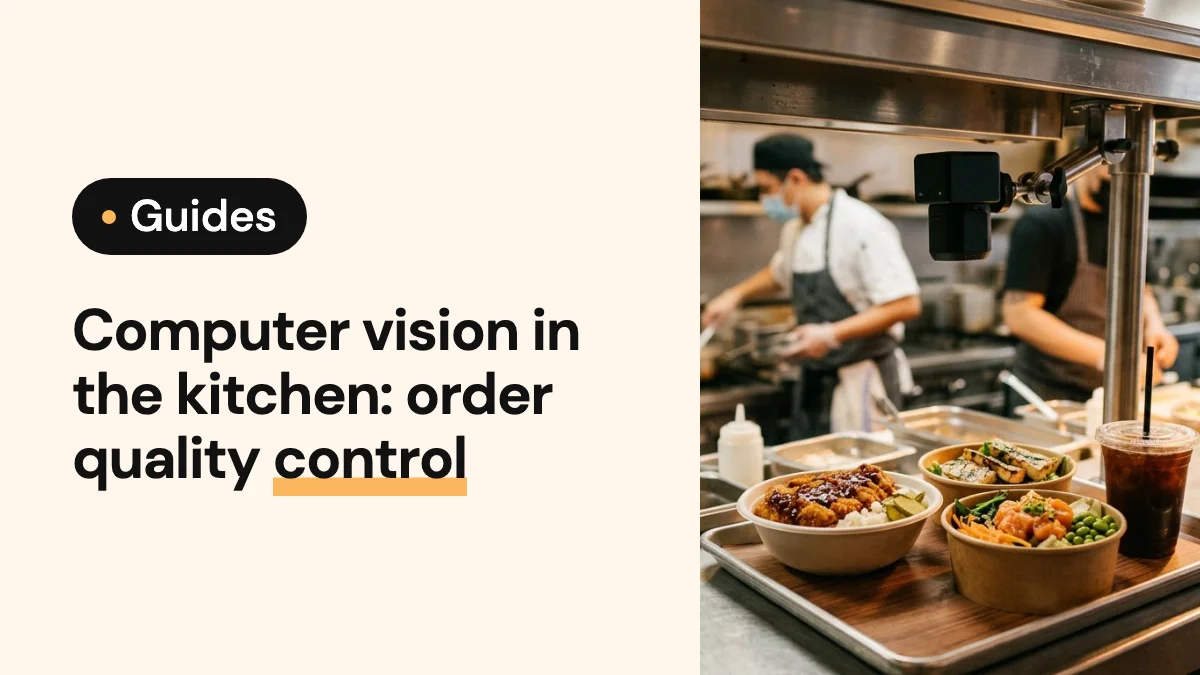
A camera on the pass photographs each assembled order and a model compares what it sees against the ticket before dispatch, storing the image against the order id. It is the only one of the three that can flag a mismatch while the order is still in the kitchen, so it prevents some errors instead of only documenting them.
The trade is that it needs the order presented consistently, in one layer, in a defined spot, plus a confidence threshold and a human override for the cases the model is unsure about.
The three approaches side by side
The honest summary is that they answer different questions. A fixed camera documents a room, a phone app documents an order when someone remembers, and computer vision checks an order and documents it as a by-product. Installation cost runs in one direction and cost per dispute runs firmly in the other.
| Fixed camera over the pass | Phone app at packing | Integrated computer vision | |
|---|---|---|---|
| What it proves | That something happened at the pass at a given time, if you can find it. | That this order was photographed, if somebody remembered. | That this order was checked against its ticket, image kept against the order id. |
| Staff effort per order | None in service, substantial per dispute. | Ten to twenty seconds, every order. | Presenting the order is part of packing. |
| Where it goes wrong | Wrong angle, obscured bag, footage overwritten. | Omission: coverage falls when service gets busy. | Misreading a lookalike item. Needs a threshold and an override. |
| Prevents or documents | Documents only. | Documents, though photographing slows packers usefully. | Both: mismatches are flagged on the pass. |
| Retrieving evidence | Search by timestamp, export a clip, hope it is legible. | Find the image, match it to the order by hand. | Open the order: the photo is attached. |
| Data protection footprint | Continuous recording of a work area: the largest. | Images on staff devices unless the app controls storage. | Frames per order, not continuous recording of people. |
Data protection when you point a camera at the pass
Aim the camera at the order, not at the team. A view framed on the tray and the docket, tight enough that faces are incidental, is a smaller data protection question than a wide shot of a work area recording continuously. Tell the team what is captured and why before you install anything, in writing.
Retention is the other decision, and the dispute windows set the floor: seven days from Deliveroo’s refund email, thirty days from the order date on Uber Eats. About a month covers both and gives you a defensible reason for the period you chose.
Continuous recording of a work area is workplace monitoring and deserves proper advice before it goes in. We describe what these systems capture, not what the law requires: check the current UK regulator guidance and your own privacy notice.
The honest limits of each approach
None of the three does everything. A fixed camera proves the room, not the order. A phone app proves the orders somebody photographed. Computer vision proves what the camera could see, which excludes anything hidden under a lid or stacked underneath something else, and it cannot tell you what happened after the bag left.
Some complaints none of them touch: a cold or leaking meal, a bag left in the sun. Anyone promising that quality complaints disappear is selling something other than evidence.
Computer vision deserves its own caveat. It works on what is visible, so packing habits have to change, and a model has an error rate. It needs a threshold that keeps false flags rare and an operator override, because a system that stops service to argue about a wrap is one the team routes around by Wednesday.
Which approach fits your operation
One site with a handful of disputes a week: a phone app and a disciplined habit will do. Several sites, a peak that overwhelms manual steps, or charges concentrated on missing items: retrieval cost is what should decide, and integrated verification is the only one of the three where retrieval is a single click.
Bronze Tracker is an example of the third approach: a tablet on the pass photographs the order, checks it against the ticket with computer vision in under one second per photo (median), and stores the image against the order id. Bronze has verified more than 5,000,000 orders across 450+ restaurants and, as of July 2026, recovered £1.89M for its customers with 83% of disputes filed with photo evidence won. The full flow, from the check at the pass to the dispute, is in missing item claims with Bronze.
Whichever you pick, the platform side is the same: Deliveroo refund disputes, Uber Eats order error adjustments, the general playbook in how to dispute unfair refunds, and the Rider Wait Fee guide for the waiting at the same counter.
Sources
The evidence requirements quoted here come from the two platforms’ own documentation, consulted on 10 September 2026. Everything about the three approaches describes how they work in a kitchen and is not quoted from any vendor. Verify the current requirements in your own partner portal before you invest.
- Uber Eats for Merchants (UK), Order errors learning centre. Consulted 10 September 2026: the photo and video evidence recommendation and the 30 day window.
- Deliveroo Partner Policies (UK), Customer compensation policy. Consulted 10 September 2026: the photo evidence requirement quoted for non-food and retail disputes, and the 7 day window.
- Just Eat Partner Hub (UK), Customer refunds and Just Eat Knowledge Centre (UK), How to manage refund claims. Consulted 10 September 2026: neither returned substantive content, so nothing is quoted.