Deliveroo’s Rider Wait Fee: what it costs and how to cut wait time at the pass
Rider waiting time used to cost you in cold food and bad reviews. Under Deliveroo’s Rider Wait Time policy it also has a per minute price, charged to the partner, and it is one of the few delivery costs you can reduce from inside the kitchen.


Every busy pass has the same scene: three riders at the counter, none of them sure which bag is theirs, and a packer answering the same question every ninety seconds. That scene now has a meter running on it.
The figures below come from Deliveroo’s Help Centre article on paying for excessive wait, which returned an error when we tried to fetch it on 10 September 2026. We have quoted the indexed text and flagged it as such.
What is Deliveroo’s Rider Wait Fee?
It is a charge to the partner for keeping a rider waiting at the restaurant beyond a set threshold, introduced with the Rider Wait Time policy effective from 19/03/2026. Deliveroo covers the waiting that happens before your prep-for time. What it charges for is the time after that, once the rider has arrived and the order is not ready.
These terms are according to Deliveroo’s Help Centre article as indexed on 10 September 2026; confirm the current figures in your Partner Hub. The logic is clear from the platform’s side: a rider parked at your counter is not earning, and unreliable ready times make the network slower. From yours it turns a soft cost, easy to ignore, into a line you can total up on Sunday night.
How the fee is calculated
The Rider Wait Fee is £0.21 per minute, payable per second by which rider wait time exceeds the 5 minute threshold, and capped at 30 minutes per order. Charging by the second matters: there is no rounding up to the next minute, so shaving forty seconds off a handover is worth real money rather than nothing.
Those figures are according to Deliveroo’s Help Centre article as indexed on 10 September 2026; confirm the current figures in your Partner Hub. Two details repay a second reading. The first five minutes are not charged, so the fee only bites on orders that genuinely were not ready. And the cap means one catastrophic wait has a ceiling, which is reassuring on the day the fryer goes down and useless as a strategy.
What it costs per order
At £0.21 per minute the individual amounts look trivial and the weekly totals do not. The table below is simple arithmetic from the published rate and is illustrative only: it assumes the whole wait above the five minute threshold is chargeable and that the 30 minute cap applies to the wait counted per order.
| Rider wait at the pass | Chargeable minutes above the 5 minute threshold | Fee for that order | Across 50 such orders in a week |
|---|---|---|---|
| 6 minutes | 1 | £0.21 | £10.50 |
| 10 minutes | 5 | £1.05 | £52.50 |
| 15 minutes | 10 | £2.10 | £105.00 |
| 30 minutes (at the cap) | 25 | £5.25 | £262.50 |
Illustrative figures calculated by us from the published rate, not amounts quoted by Deliveroo. The last column is the point: this is a peak hour problem, and the same orders produce the bill every week.
Why prep-for time is the number that protects you
Prep-for time is the estimate that decides when a rider is sent to you, and Deliveroo covers the waiting that happens before it. Set it too short and riders arrive to an order still on the grill, on your meter. Set it honestly for a Saturday peak and the rider arrives as the bag is being sealed.
Operators resist lengthening it because a longer quoted time looks worse to the customer. The trade is narrower than it appears: the customer waits for the food either way, and the version where the rider idles at your counter for eight minutes delivers colder food. Accuracy beats optimism, and one prep-for time for every daypart is the most common mistake.
Order Ready and Rider Check-in: the signals the policy runs on
Deliveroo encourages partners to use Rider Check-in and Order Ready. Both are the instrumentation the fee depends on: check-in records when the rider actually arrived, Order Ready records when the bag was actually ready. Without those two timestamps, waiting time is an argument. With them it is data.
That is also what makes a charge reviewable. If you believe a wait was recorded against you when the rider arrived early or was not at the counter, the only useful thing you can produce is your own record of arrival and ready times. Kitchens that mark Order Ready when the bag is sealed, rather than when the last item leaves the fryer, get a cleaner picture and a fairer one.
Where handover delay actually comes from
Rarely from slow cooking. The recurring causes are a rider arriving before the food is due, nobody knowing which rider is waiting for which order, a finished order sitting unclaimed on the shelf, and a language gap at the counter that turns a ten second exchange into a minute of gestures.
The last one is underrated. The counter conversation happens between a packer and a rider who may share no first language, and every repetition is chargeable time. Cutting wait time is mostly about removing the need for the conversation: the rider knows the order is not ready yet, and the kitchen knows who is waiting for what.
How Bronze Riders documents and reduces wait at the pass
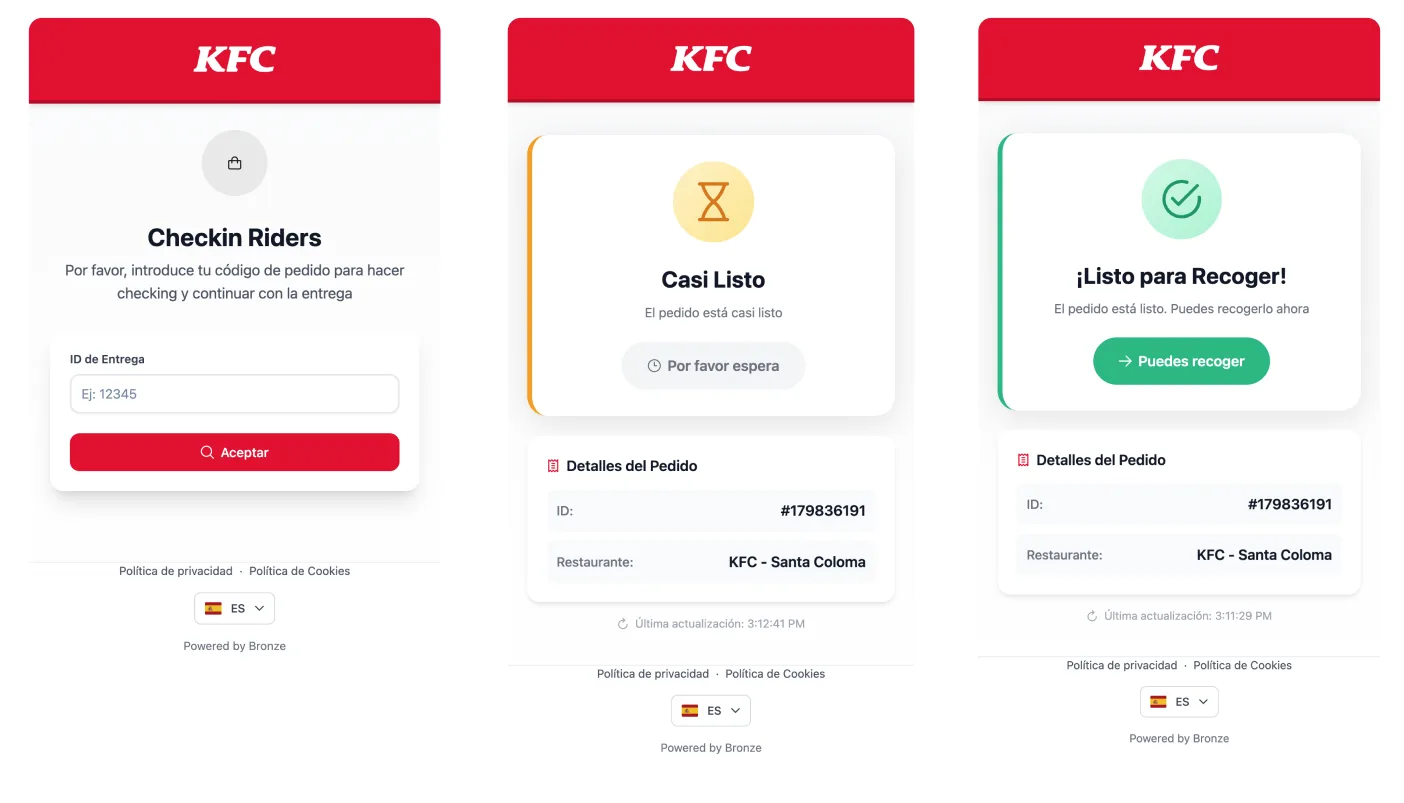
Bronze Riders puts a QR code at your entrance. The rider scans it, with no app to install, enters their platform order code, and the check-in is validated by geolocation within 200 metres of the site. From then on they follow the status on their own phone: in the kitchen, almost ready, ready to collect, with sound and vibration when it changes.
In the kitchen the arrival appears on the Tracker tablet with a code readable from two metres away, a count of waiting riders stays in view, and the alert escalates if a wait passes two, four or six minutes. An order is only marked ready once verified with computer vision, so nobody is called forward to an incomplete order. The rider app speaks six languages, which removes most of the counter conversation.
It also leaves a log of waiting and handover times by site, which is the part that matters for this fee: you can see which sites and dayparts generate the waiting, and you hold your own record next to the platform’s. See Bronze Riders for how check-in works, and Deliveroo refund disputes for the other charge that lands in the same weekly review.
What to measure weekly
Five numbers, by site and by daypart: median time from rider check-in to handover, the share of orders passing the five minute threshold, the total wait fee charged, how often Order Ready fires before the rider arrives rather than after, and the gap between your prep-for time and your actual prep time.
The fifth changes behaviour. When actual prep time at 20:00 on a Saturday runs consistently longer than the prep-for time, the fee is not a failure at the pass: it is a forecasting error upstream, fixed by editing a number rather than by shouting across a kitchen. If the same review turns up refund charges, the Uber Eats 30 day window and the evidence comparison cover what you need to contest them.
Sources
The policy figures here come from Deliveroo’s Help Centre article on excessive wait as indexed on 10 September 2026, when the live page returned an error to us. The cost table is our own arithmetic from the published rate, labelled illustrative. Confirm the current rate, threshold and cap in your Partner Hub.
- Deliveroo Help Centre, Pay for Excessive Wait. Consulted 10 September 2026: the page returned a 404 to our request, so the figures above are quoted from the indexed text.
- Deliveroo Partner Policies (UK), Customer compensation policy. Consulted 10 September 2026.
- DoorDash investor relations, DoorDash Completes Acquisition of Deliveroo. Consulted 10 September 2026.