How to handle bad reviews in the Glovo portal
Negative ratings do not just lower your score: they affect your visibility in the app and therefore your sales. The good news is that almost all of them point to a specific, fixable cause.
A guide for operations managers, franchisees and dark kitchens. If you are a Glovo customer wanting to claim on your own order, the channel is Glovo customer help, from the Help section of your profile in the app.

The Glovo portal now gives considerably more detail on customer feedback than it did a couple of years ago: average score, week-on-week trend and the full list of reviews with their comments. The problem is no longer getting at the bad reviews, it is knowing what to do with them before they turn into deductions.
Where do you find bad reviews in the Glovo portal?
There are two routes. On the home dashboard, the customer reviews block summarises your average score, the most recent ratings and whether you are improving or slipping compared with the previous week. For the full detail, the reviews section in the side menu shows the complete list, positive and negative, with each customer's comment and the site's average rating.
What to look at in each negative review
A bad review without context is an opinion. With context it is operational data. These are the four things worth noting about each one:
- The stated cause: a missing item, a prep mistake, temperature, packaging or delivery time.
- The site and the shift: the same problem on two different shifts rarely has the same root cause.
- The specific item: there are almost always two or three dishes accounting for half the complaints.
- Whether a refund was attached: that tells you whether, on top of the reputational damage, there was damage to your statement.
With those four columns in a spreadsheet you have, within a week, a far more useful map than the average score, which rises and falls without telling you anything you can act on.
Why the review arrives before the refund
In practice, a negative rating is usually the first warning of a problem that later shows up as money. The customer rates you badly, and sometimes complains; if they complain, the complaint appears on the order and with it the possibility of a deduction. Working through reviews is the cheapest way to avoid deductions, because you act on the cause before it repeats.
And not only because of the money: in Glovo's ranking system ratings are part of the performance factor, along with delivery time and cancellation rates, so the score drags visibility as well as reputation.
If you want the detail on those labels and when you are actually charged, we explain it in our guide to Glovo refunds.
Replying is good, checking is better
Replying quickly and politely helps win the customer back, and on platforms with public replies it also helps whoever is reading. But replying does not close the loop: to close it you need to know whether the mistake was real.
That is where a review becomes verifiable. If every order leaves the kitchen photographed and verified with computer vision, a complaint about a missing item is checked in seconds: either the item was in the bag or it was not. If it was, you have what you need to dispute the refund. If it was not, you have a genuine case to fix in your process.
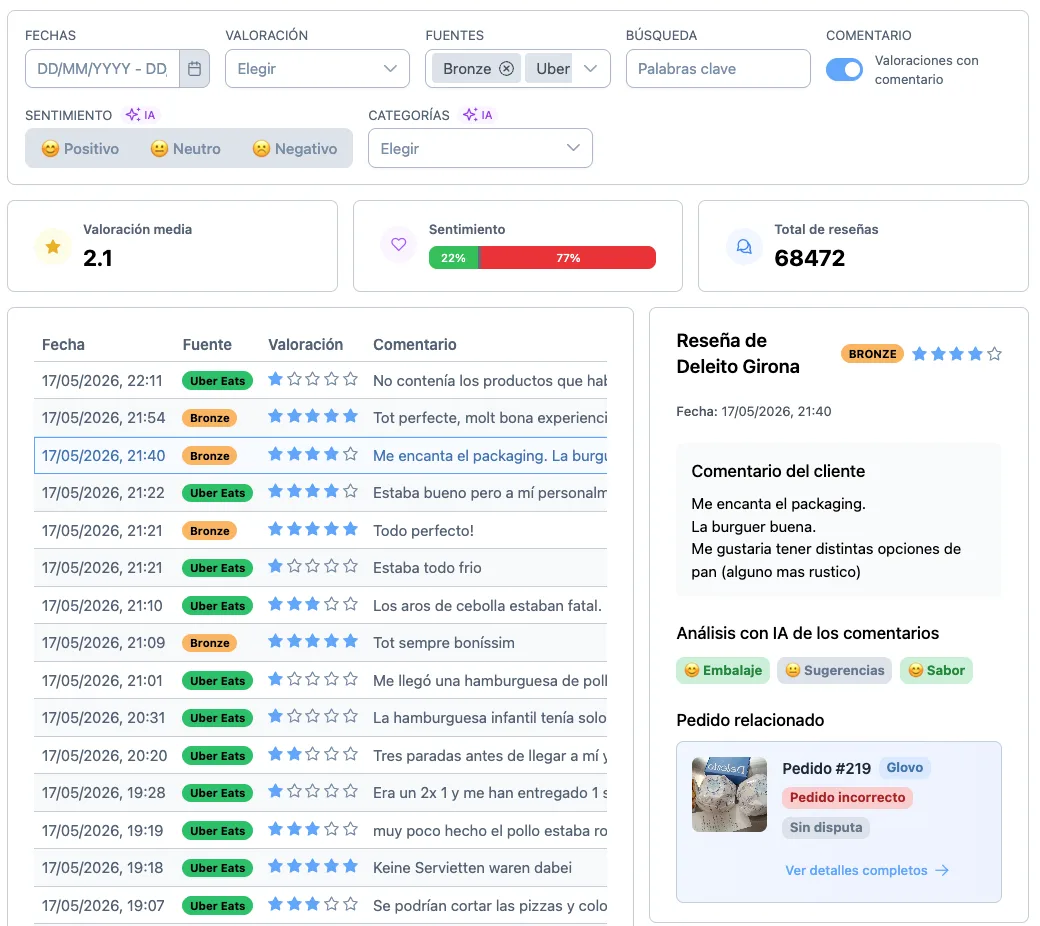
Bronze Feedback brings reviews from Glovo, Uber Eats and Just Eat into a single dashboard, classifies them by cause and links them to the order verified by Bronze Tracker. It also adds a survey of your own, sent to the customer after delivery, which is the feedback the platforms will not give you.
On Uber Eats the rating carries similar weight: its Top Eats programme reviews five metrics from the last 90 days every month, among them the average star rating and the incorrect order rate.
Pay more attention to the repetitive than to the severe. One isolated scathing review is usually a bad day; three middling reviews about the same product are a process problem that will repeat every week.
A weekly routine that works
- Export or note down the week's low-scoring reviews.
- Classify them by cause and by product, not by severity.
- Pick a single cause: the most repeated one. Fix it with the team that week.
- Check the following week whether that cause has fallen. If it has not, the change was not the right one.
- Flag the reviews whose complaint does not match what left the kitchen: those are candidates for a dispute.
What to take away
- The portal gives you the score; the value is in the reason, the product and the shift.
- A negative review is the early warning of a refund that has not arrived yet.
- With the photo of the order you can tell a legitimate complaint from one that is not, and act differently in each case.
Sources
- Glovo, ranking system for placement in the app: sell.glovoapp.com. Consulted 10 September 2026.
- Uber Eats, Top Eats programme: merchants.ubereats.com. Consulted 10 September 2026.
- Glovo, customer help: glovoapp.com. Consulted 10 September 2026.