Check in the kitchen or claim afterwards: which recovers more money
Claiming afterwards from the statement data, or checking every order before it leaves. The deadlines, the cost and the limits of each.

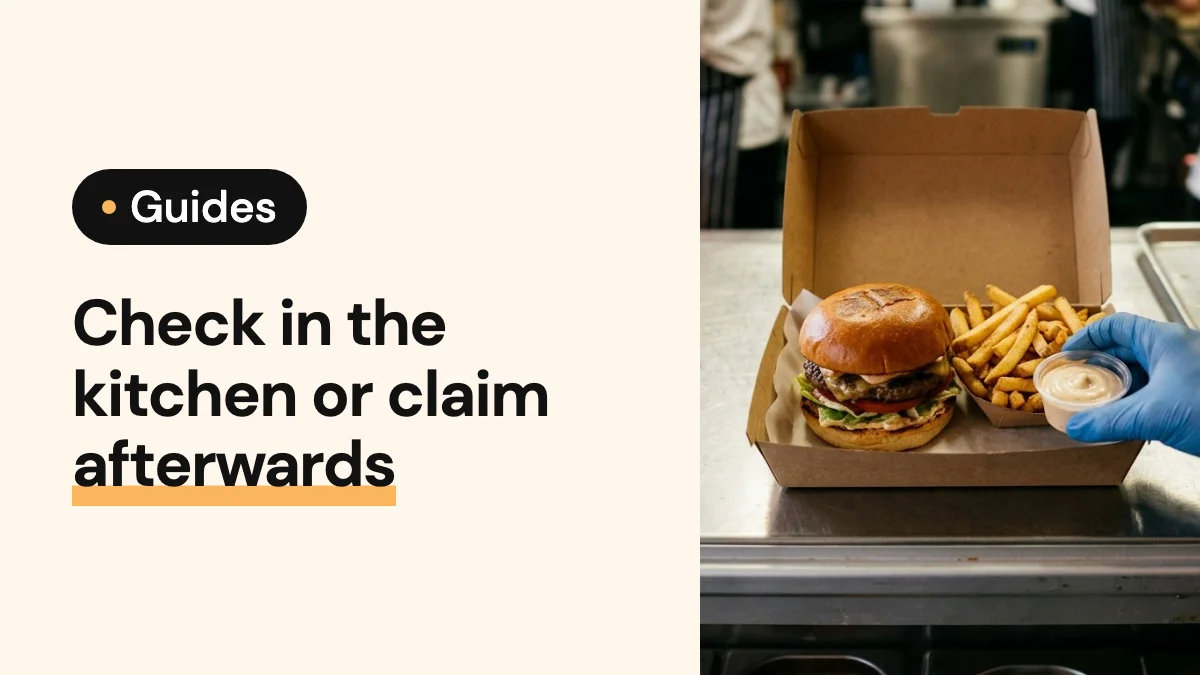
There are two ways for a restaurant to stop losing money on order mistakes, and they compete for the budget and for the manager's time: cross-checking statements to find charges that do not add up, or checking every order before it leaves.
Which recovers more money: checking in the kitchen or claiming afterwards?
Claiming afterwards recovers only the visible layer of the cost, the amount deducted, and only within the window each platform allows. Checking every order before it leaves prevents the whole mistake (refund, food, admin, review and visibility) and it also produces the proof used to claim back whatever does arrive unfairly. The order that recovers most is check first, claim afterwards.
The two strategies, one sentence each
Claiming afterwards means reconstructing what happened from the statement data: identify the charge, find the order, ask the shift and dispute with whatever anyone remembers. Checking beforehand means photographing every packed order, letting computer vision compare it against the docket, correcting on the spot and keeping the photo as evidence.
The first is an admin task that happens weeks after service; the second is a kitchen gesture inside service. That is why the comparison is settled by looking at which layers of cost each one touches.
Compared: what each one prevents, documents and costs
The difference is not accuracy, it is timing: one acts once the money has already gone and the other while the order is still on the pass. The table compares them across seven criteria, including the two that are almost never written down: what happens to the mistake that really was the kitchen's, and what effect each one has on ratings.
| Criterion | Claiming afterwards, from the statement | Checking before it leaves and claiming with a photo |
|---|---|---|
| What it prevents | Nothing: the mistake has happened and the customer has already lived it. | The whole mistake: refund, food, admin, review and visibility. |
| What it documents | The charge and the reason the platform declares, plus whatever the shift remembers. | The real contents of the bag with date and time, compared against the docket. |
| What it needs from the platform | That the portal itemises the charge and offers a dispute channel. | The same to dispute, and nothing at all to prevent. |
| Deadlines | Whatever each platform sets, and it is short. | Prevention does not expire; the dispute inherits the window with the proof already in hand. |
| Running cost | Manager hours every week, indefinitely. | One gesture per order, with the analysis in under a second per photo. |
| The mistake that really was the kitchen's | Nothing to do: the charge is correct. | It is caught and fixed before the bag is sealed. |
| Ratings and ranking | None: the review and the metric are already on record. | Direct: a complete order does not generate a missing items review. |
Deadlines are the hard limit of claiming afterwards
Claiming afterwards expires, and sooner than it looks. On Uber Eats, a dispute over an order error adjustment is filed within 30 days of the date of the original order, using the self-service tool in the management portal. On Deliveroo, the window is 7 days from the refund notification email.
That 30-day window and the errors it covers (missing items, wrong items, orders not delivered and late deliveries) are set out in the Uber Eats help page on refunds for incomplete or incorrect orders. For Deliveroo, the Deliveroo partner policies, updated on 14 July 2026, ask you to log into the Hub within 7 days of the refund email and dispute by order number.
On the Glovo pages we consulted on 10 September 2026 no window for disputing a deduction is published; what is published is that operational metrics are watched in the Operations section of the Manager Portal, according to its page on avoidable courier wait time. The operational reading: claiming afterwards forces a weekly rhythm, because a monthly review leaves charges out of time.
What happens to the mistake that really was the kitchen's
Here the two strategies part company entirely. If the item really was missing, claiming afterwards has nothing to work with: the charge is correct and disputing it burns time and credibility. Checking beforehand is the only one that acts on that case, because it catches it with the order still on the pass and turns it into a thirty-second correction.
And that is the half of the problem that almost never enters the calculation. A strategy built on claiming alone assumes every mistake belongs to somebody else, and they do not: at Nugu Burger, with 99.2% of orders verified, more than 11% of them had to be corrected.
The effect on ratings and on the app ranking
Claiming afterwards recovers pounds and leaves reputation untouched: the negative rating and the metric were already on record when the customer complained. Checking beforehand acts on both, because an order that leaves complete does not generate a missing items review and does not enter the platform's incorrect order count.
And that carries weight. In its ranking system, Glovo groups ratings, delivery time and cancellations into a single factor, performance. On Uber Eats, the Top Eats badge reviews five metrics from the last 90 days every month, among them the incorrect order rate. The pound comes back; the place in the listing does not always.
The limits of photo verification
A photo proves what left the kitchen, not what arrived at the door. It does not cover what happens in transit, it does not see inside a sealed container, it does not judge temperature or taste, it depends on the team keeping the habit of showing every order, and it does not oblige the platform to accept the dispute: that decision stays theirs.
- Transit is out of scope. An order that leaves complete can arrive spilled. The photo bounds responsibility, it does not remove it.
- What is sealed cannot be seen. If the item travels inside a closed box, what is checked is that the box is there, not what is inside it.
- Coverage is either kept up or it slips. The first sign that a shift has stopped verifying is coverage dropping, and the evidence goes with it.
- The platform decides. Evidence changes the ground the conversation happens on, not the outcome: well-founded disputes do get lost.
The procedure with that evidence in hand is in the guide to claiming unfair refunds, and the calculation of what a mistake costs is in the guide to the cost of order mistakes. The dispute side is on refund disputes on Deliveroo, Uber Eats and Just Eat.
What we see when both are done
When evidence goes with the claim, the conversation with the platform stops being your word against the customer's. With the photo of the order exactly as it left the kitchen, Bronze wins 83% of the disputes it files (disputes resolved in the last 12 months, July 2026), and verifying each photo takes a median of under one second.
Bronze Tracker covers both halves with the same gesture: it flags before the bag is sealed and leaves the photo documented for the dispute. Our figures as of July 2026: 5,000,000 orders verified across more than 450 restaurants and £1.89M recovered for our customers.
Sources
- Uber Eats, managing refunds for incomplete or incorrect orders: help.uber.com. Consulted 10 September 2026.
- Deliveroo, partner policies, updated on 14 July 2026: merchants.deliveroo.com. Consulted 10 September 2026.
- Glovo, avoidable courier wait time: sell.glovoapp.com. Consulted 10 September 2026.
- Glovo, ranking system for placement in the app: sell.glovoapp.com. Consulted 10 September 2026.
- Uber Eats, Top Eats programme: merchants.ubereats.com. Consulted 10 September 2026.